

The short answer: every guitarist needs a tuner, a handful of picks, a spare set of strings, a strap, and a stand or case to keep the guitar safe and within reach. If you play electric, add one more thing: a cable plus an amp or a pair of guitar headphones, because an electric guitar is very quiet on its own. Everything else can wait until you're practicing regularly, playing with other people, or recording.
Your guitar just showed up, it's out of the box, and you're ready to play. Then the questions start. Do you need a tuner if your phone has an app? Does an acoustic need anything special? Search "guitar accessories" and you'll get a wall of 25 items with no sense of which ones matter today.
So we sorted this list by when you'll actually need each thing: day one, once you're practicing every day, and once you start playing with others or recording. Wherever electric and acoustic players need different things, we say so. And for every item, we tell you what it needs to work, so you don't get home and find out you're missing a cable.
| Accessory | Who needs it | When | What it needs to work |
|---|---|---|---|
| Tuner | Every guitar | Day one | A phone app works at first |
| Spare strings | Every guitar | Day one | The right type for your guitar |
| Cable | Electric | Day one | An amp or headphones to plug into |
| Amp or guitar headphones | Electric | Day one | A cable or a wireless transmitter |
| Humidifier | Acoustic | Day one in dry climates | A case and a refill every week or two |
| Wireless | Any instrument with an output | Playing out | Any amp |
| Footswitch | Spark or REACTOR owners | Playing out | The matching amp |
| Audio interface | Every guitar | Recording | A computer (your amp may be one) |
Essential guitar accessories for every player (day one)
These are the must-have guitar accessories that keep you from getting stuck on your first night.
Tuner
A tuner keeps you in tune, and it works with any guitar. On day one, a free phone app is honestly enough. Once you play every day, a clip-on tuner that grabs the headstock is faster and doesn't care how noisy the room is. For a full rundown of the options, read our guide to guitar tuners.
Picks
Picks are for strumming and picking single notes, and they need nothing but a pocket to live in. Buy more than you think you need, because they vanish.
Spare strings
Strings break, usually right before you want to play. Keep one spare set around, and make sure it's the right type: electric strings for electric, acoustic strings for acoustic, bass strings for bass. They aren't interchangeable.
Strap
A strap holds the guitar when you stand up to play. It needs two strap buttons on the guitar, which almost every electric and most acoustics have.
Stand or case
A guitar on a stand gets played. A guitar in a closet mostly doesn't. A floor stand keeps it safe and within reach, while a case is the better home if you have pets, kids or a dry room.
Electric guitar accessories: what you need to plug in
Here's the one that catches new electric players: an electric guitar is very quiet unplugged. To hear it properly you need two things, a cable and something to plug into.
Instrument cable
A standard 1/4" instrument cable runs from your guitar to your amp. It works with any electric guitar, bass, or acoustic with a pickup. Buy a decent one and keep a spare, because a bad cable can end a practice session before it starts.
An amp or guitar headphones
You need either a guitar amp or guitar headphones, and the right choice depends on where and when you play.
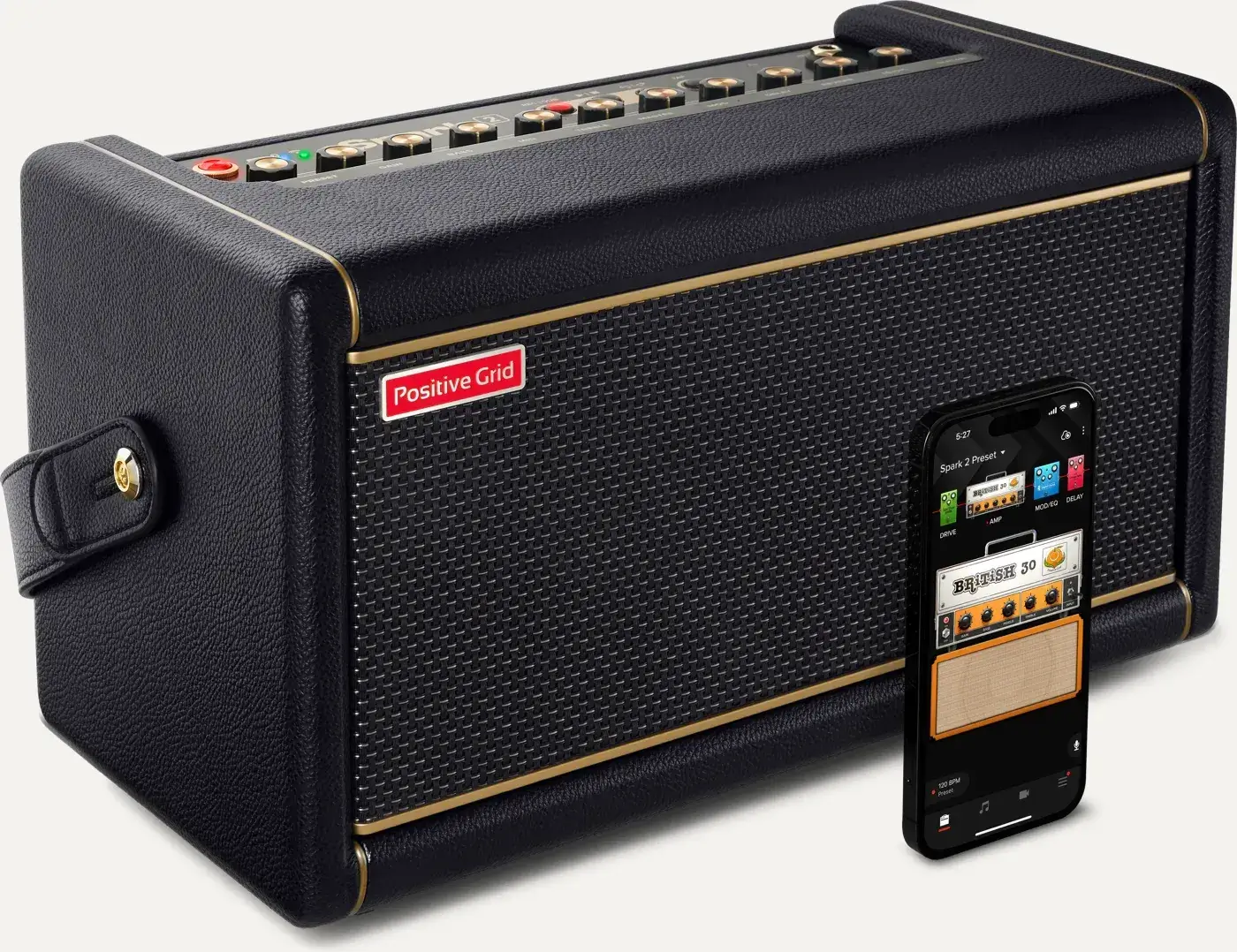
For most home players, a small modern practice amp does everything you need. Positive Grid's Spark 2 is the one we'd point most people to, with amps for electric, bass and acoustic, a headphone out for quiet nights, and an app full of tones to explore. If you want something small enough to carry from room to room, Spark GO sits on a desk, runs on a rechargeable battery, and still has a headphone out. Spark MINI is another small, battery-powered option.
If you mostly play after everyone else goes to bed, guitar headphones may suit you better (more on those below). For the full walkthrough, read how to choose your first guitar amp.
Acoustic guitar accessories
Acoustic players skip the cable and amp, but they pick up a few needs of their own, mostly about protecting the wood.
Humidifier
A guitar humidifier keeps an acoustic's wood from drying out, which is what causes cracks and lifting bridges. It needs a case to work in, plus a refill every week or two. If you live somewhere with dry winters or run the heat a lot, treat this one as day-one gear.
A real case
Acoustics are more fragile than electrics. A padded gig bag is fine for short trips, but a hard case protects better and holds humidity in. It needs to match your guitar's body shape.
Capo
A capo clamps across the neck so you can play songs in a new key with the chord shapes you already know. It works with any steel-string acoustic or electric. Classical guitars need a capo made for their flatter neck.
If your acoustic has a pickup
If your acoustic has an output jack, you can plug it in. Spark 2 has dedicated acoustic amps, and Spark LINK works with any instrument that has an output, acoustics included.
Guitar accessories for beginners who practice every day
Once playing becomes a habit, a few small things remove the friction between you and the guitar, so it's easier to pick it up more often.
Guitar picks for beginners
Picks come in thin, medium and heavy. Thin picks are forgiving for strumming, heavy picks give more control for single notes, and medium sits right in the middle. If you're starting out, a variety pack is the easiest way to find out what feels right in your hand.
Stand within reach
If your guitar lives in its case, move it to a stand next to where you sit, because a guitar you can grab in two seconds gets played more. If you practice in more than one place, here's how to build a complete practice rig that fits in one backpack.
Music stand or phone holder
A music stand or a phone holder keeps chord sheets, tabs and video lessons at eye level. It needs nothing except whatever you read from, paper or screen.
Metronome
A metronome keeps your timing honest. A free app is perfectly fine. If you'd rather play along with drums, the built-in looper with drum patterns on Spark 2 does the same job and is more fun.
Guitar headphones for late nights
Headphones let you practice at full volume without anyone else hearing it. Any amp with a headphone out works with regular headphones. If you want to drop the amp entirely, Spark NEO is a set of wireless guitar headphones with Spark's amps and effects built in. The included transmitter plugs into your guitar, or you can use a standard cable. It works with electric, acoustic with a pickup, and bass, and it doubles as Bluetooth® headphones for music when you're done playing. Here's more on how Spark NEO is changing the way guitarists practice.
Guitar care and maintenance accessories
A few small tools keep your guitar playable and save you trips to the repair shop.
String winder and cutter
A string winder spins the tuning pegs quickly when you change strings, and the built-in cutter trims the extra length. It works with any guitar and turns a chore into a few minutes' work.
Cleaning cloth and polish
A soft cloth after every session wipes off the sweat and oil that slowly wear down the finish, and wiping your strings helps them sound fresh for longer. Polish is for every so often, and it needs to be safe for your finish type.
Basic tool kit
A small kit with the right hex keys and screwdrivers lets you tighten a loose strap button or adjust string height. It needs to match your guitar's hardware sizes. If you're not sure about a truss rod adjustment, that's what a guitar tech is for.
Acoustic players, keep that humidifier filled through the dry months too.
Guitar accessories for playing live and with others
Once you're jamming with friends or playing a show, the list changes. Now it's about getting there in one piece, being heard, and moving around.
Gig bag or case
A padded gig bag protects the guitar for rehearsals and local shows, and the pockets hold your cable, tuner and picks. Match it to your guitar's body shape.
A spare cable and earplugs
Pack a spare cable, because cables fail at the worst moment. And bring earplugs. Band practice is loud, and musician's earplugs cut volume without making everything sound muffled.
Wireless
A wireless system replaces the cable between your guitar and amp so you can move around without tripping. Spark LINK works with any amp, and with guitar, bass, acoustic or any instrument with an output. It has four channels, so up to four players in the same band can run their own at once. To see it on a real stage, read about playing live shows (on national television) with Spark LINK.
A footswitch
A footswitch lets you change sounds without bending down to the amp. Spark Control X is a wireless footswitch with six switches for swapping presets and toggling effects. It works with Spark series amps only. If you play REACTOR, the matching footswitch is REACTOR Control, which is made only for REACTOR amps.
More volume
If you own a Spark amp and need more volume for a jam or a gig, Spark CAB 2 is a powered full-range cab that turns your Spark into a full rig for home, rehearsal and stage. From one wall outlet, it can power Spark 2 and Spark 40, or power and charge Spark MINI, Spark GO and Spark PEDAL. It also works as a full-range cab for a modeler, pedal or amp you already play at line level. If you don't own a Spark or a rig like that, it isn't the speaker for you.
Battery power
For Spark 2, Spark EDGE and Spark LIVE, an optional Spark Battery lets you play away from an outlet, and it swaps out in seconds.
Guitar accessories for recording
When you're ready to record yourself, the usual next step is an audio interface, a box that connects your guitar to a computer. Check your amp first, though, because it may already be one. Spark 2, Spark GO and Spark MINI all work as USB audio interfaces, so one cable to your computer gets you recording. REACTOR, a new kind of amp built on Amp Intelligence™, records direct to any DAW over USB-C.
Guitar software
Tone software lets you shape amp and effects sounds on your computer. BIAS X runs on a Mac or PC, either on its own or as a plugin inside your recording software. You can describe a tone in words and BIAS X builds it. It needs a computer and an audio interface to play through, which can be your Spark amp. Once you're set up, try building your own signal chain in BIAS X.
Accessories for bass players
Most of this list carries over. Bass players need a tuner, spare bass strings, a strap that can handle the weight, and a stand. A pick is optional, since plenty of bassists play with their fingers. When you plug in, Spark 2 has dedicated bass amps, Spark NEO works with bass for silent practice, and Spark LINK works with bass too.
What you don't need yet
This is the honest part. Plenty of gear is worth owning eventually, just not in your first months.
Guitar accessory kits
Kits look like a deal, but the parts are often lower quality and you lose the chance to pick what you actually like.
A flight case
Flight cases are built for airplanes and touring vans. A gig bag or standard hard case covers everything else.
Wireless for bedroom practice
Wireless is great on a stage. At home, five feet from your amp, a cable works just as well.
A pedalboard full of pedals
Pedals are fun, but a modern amp with built-in effects lets you find out what you like before you spend on a board. For more on this, read why carrying too much gear slows down your playing.
A slide (for now)
A slide is a great second-year experiment. When you're ready, start with our slide guitar guide for beginners.
Buying guitar accessories as a gift?
If you're shopping for a guitarist this December, the safest picks are the ones that get used up or lost: strings, picks and a good cable. For more ideas, see our guide to the best gifts for guitar players.
Gear in this post
Beyond the gear above, Spark GO owners can protect their amp with the Spark GO Case, a custom carry case with an accessory compartment. You can browse everything else in Positive Grid accessories, or go straight to Spark 2 accessories.
Guitar accessories FAQ
Do I need an amp for an electric guitar, or can I use headphones?
You need one or the other. An amp is easier for jamming with friends, and headphones are better for late-night practice. Many amps have a headphone out, so you can do both.
What accessories does an acoustic guitar need?
The same basics as any guitar, plus a humidifier, a real case, a capo, and a cloth for cleaning. If your acoustic has a pickup, add a cable and an amp with acoustic amps built in.
Are guitar accessory kits worth it?
Usually not. Kit parts tend to be lower quality, and buying a few good basics separately lets you choose what actually suits you.
How often should I change guitar strings?
It depends on how much you play. Change them when they sound dull, won't stay in tune, or feel rough or discolored. If you play most days, that comes around sooner than you'd expect.
The short list, and where to get it
- Day one: tuner, picks, spare strings, strap, stand or case
- Electric adds: a cable plus an amp or guitar headphones
- Acoustic adds: humidifier, a real case, capo
- Once you practice daily: a stand within reach, a metronome, headphones
- Playing out: gig bag, spare cable, earplugs, wireless, a footswitch
- Recording: an audio interface (check your amp first) and tone software
- Where to buy: grab strings, picks and a stand at a music shop near you, then read how to choose your first guitar amp.